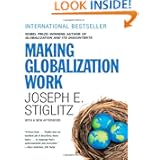
Stiglitz's seminal Globalization and Its Discontents (2002) argued that globalization has not benefited as many people as it could, a failure attributable to structural flaws in international financial institutions as well as limited information and imperfect competition. With this selection, the Nobel Prize-winning economist suggests a host of solutions by which globalization can be "saved from its advocates" and made safe and worthwhile for the poor and rich alike. Each chapter examines, in some depth, an obstacle to equitable globalization (the burden of massive national debt, for example) and provides a set of possible solutions (a return to countercyclical lending and development of international bankruptcy laws, for example). Many of Stiglitz's proposals echo the familiar litanies of developing nations in the Doha round of international trade talks, but several, such as those drawing upon East Asia's experiments in contained progress, are innovative enough to warrant books of their own. Fairly accessible for a work of macroeconomics, this is a worthy counterpoint to Thomas Friedman's popular The World Is Flat (2005). Brendan Driscoll
Books
mandag den 8. august 2011
Climate Capitalism: Capitalism in the Age of Climate Change
Product Description
Believe in climate change. Or don’t. It doesn’t matter.
But you’d better understand this: the best route to rebuilding our economy, our cities, and our job markets, as well as assuring national security, is doing precisely what you would do if you were scared to death about climate change. Whether you’re the head of a household or the CEO of a multinational corporation, embracing efficiency, innovation, renewables, carbon markets, and new technologies is the smartest decision you can make. It’s the most profitable, too. And, oh yes—you’ll help save the planet.
In Climate Capitalism, L. Hunter Lovins, coauthor of the bestselling Natural Capitalism, and the sustainability expert Boyd Cohen prove that the future of capitalism in a recession-riddled, carbon-constrained world will be built on innovations that cutting-edge leaders are bringing to the market today. These companies are creating jobs and driving innovation.
Climate Capitalism delivers hundreds of indepth case studies of international corporations, small businesses, NGOs, and municipalities to prove that energy efficiency and renewable resources are already driving prosperity. While highlighting business opportunities across a range of sectors—including energy, construction, transportation, and agriculture technologies—Lovins and Cohen also show why the ex–CIA director Jim Woolsey drives a solar-powered plugin hybrid vehicle. His bumper sticker says it all: “Osama bin Laden hates my car.”
Good To Great (2010)
Good to Great: Why Some Companies Make the Leap... and Others Don't is a 2001 management book by James C. Collins that aims to describe how companies transition from being average companies to great companies and how companies can fail to make the transition. "Greatness" is defined as financial performance several multiples better than the market average over a sustained period of time. Collins finds the main factor for achieving the transition to be a narrow focusing of the company’s resources on their field of competence
The Wisdom of Crowds
The Wisdom of Crowds: Why the Many Are Smarter Than the Few and How Collective Wisdom Shapes Business, Economies, Societies and Nations, published in 2004, is a book written by James Surowiecki about the aggregation of information in groups, resulting in decisions that, he argues, are often better than could have been made by any single member of the group. The book presents numerous case studies and anecdotes to illustrate its argument, and touches on several fields, primarily economics and psychology.
Abonner på:
Kommentarer (Atom)